Golf Digest Obama/Tiger Cover: Hilarious Fail
Patricia | Dec. 23, 2009

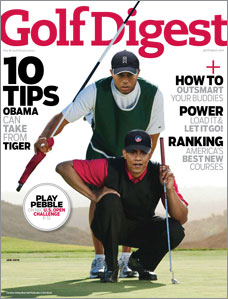
tigerobamacoverNothing quite sums up the differences between print and new media like the January 2010 cover of Golf Digest. Print — despite the likely fervent wishes to the contrary of the editors who came up with, “10 Tips Obama Can Take From Tiger” — is forever.

The story is not available online but promises, “Writers and players share what they think the president can learn from the world’s best golfer — and vice versa.” The mind reels at the possibilities of what Obama could learn from Tiger, but let’s face it, there’s only one thing we can think of that Tiger might learn in return: “Keep it in your pants, son!”

A Product in Search of a Problem to Solve
Patricia | Dec. 6, 2009

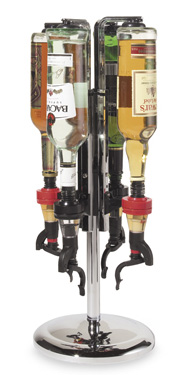
cocktailcarouselThe four P’s of marketing are product, price, place (as in, where the product – or service – is available), and promotion. Marketers should have a role in designing the product, ostensibly because we know what the public wants. So who, I’m wondering, wants a cocktail carousel?

Let’s look at the original product: a bottle of booze. In order to dispense the contents, you must twist off the top and tilt it over a shot glass. When the glass is full, you straighten the bottle out and twist the top back on.

With the cocktail carousel, you take the original product, twist off the top, attach the dispensing apparatus, turn the bottle upside down, fit it into the carousel, hold a shot glass under the dispenser, and flip the lever. Wow! That’s so much easier!

Maybe the product is intended to help after you’ve been using it awhile, say after your fourth shot when tipping that bottle over a tiny glass gets trickier. On the other hand, according to the description, the red levers allow 1.5 shots to come out, the black ones provide “continuous flow.” Hilarity no doubt ensues as we try to remember if it’s the red one or the black one. And where is the red one anyway? How about if we just lay down under the black one with our mouths open?

I know this will probably be a popular item under the tree, what with people doing shots like nobody’s business in these tough economic times. Still, I can’t help but feel the cocktail carousel answers a question no one asked.

Dare to View Holiday Decorating Ideas from Real People
Patricia | Dec. 2, 2009

Everyone has their favorite time-waster web site, where they go to confirm the superiority of their personal tastes over others. People of Wal-Mart certainly springs to mind. But for a real look into the psyche of Americans, not to mention their living rooms, I love the Better Homes and Gardens “100 Days of Holidays,” where the reader-submitted pictures are off the chain.

ss_4455107_large

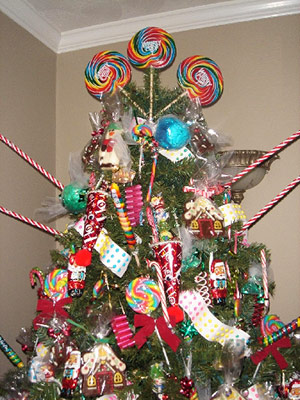
I can’t see using this theme in Florida, where the humidity would have those suckers dripping in no time.

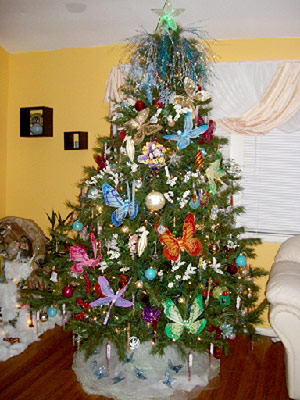
ss_5394000_slideshow

There is no way to view this tree and not get a mental image of the home owner. I can see her now…

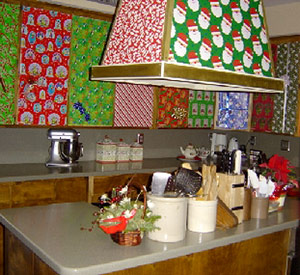
ss_374998imp_slideshow

If you were going to all the trouble to wrap your cabinets and range hood in gift paper, wouldn’t you use the good stuff?

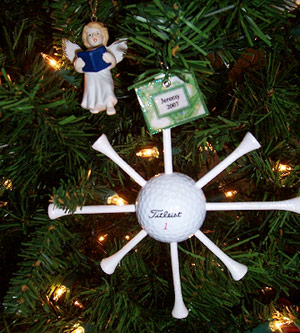
ss_373605imp_large

This just makes me sad. Poor Tiger. Something tells me his Christmas will be neither merry nor bright.

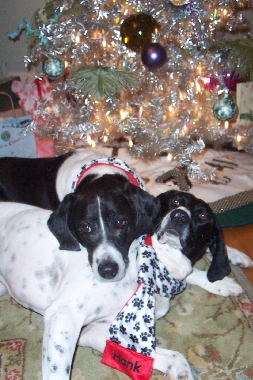
373338imp_slideshow

Of course, my favorite is this shot someone submitted of a two-headed dog under the tree. Clever!

The Best Time to Contact Donors
Patricia | Nov. 18, 2009

handsJeff Brooks always makes great points in his column for Fundraising Success magazine, but a recent column about how often an organization should ask for donations had several. And it looks like the best time to contact potential donors is…

Any time.

I’ve yet to find any evidence that asking donors less makes them more responsive. In every test I’ve seen of contact frequency, donors on reduced-contact schedules give less often and lapse at higher rates.

Donations are not mere transactions; they are the result of a relationship between you and your donor, and relationships are complicated. A donor’s decision to give might not be motivated only by the piece of mail she received today, but by a whole matrix of interactions. It may take two, three or more points of contact to create the tipping point that leads to a gift.

A more paranoid way to look at it: While you are letting your donors “rest,” someone else is talking to them, asking for gifts — and possibly getting them!

The fundraiser/donor relationship is like any other human relationship: Communication builds it; lack of contact can strangle it.

Brooks also has a wonderful idea for how to stay in touch.

Send newsletters: Donors usually respond positively to newsletters. They are a great way to thank donors and show them what their giving accomplishes. For many organizations, newsletters are as effective at raising funds as appeal letters — sometimes better. If you aren’t sending a newsletter, start now!

Hey, why didn’t I think of that? Oh yeah, I did.

Newsletters are one of the best ways organizations can help donors understand and support their missions. They are also a great vehicle for donor recognition. A profile of the donor and what it is about your cause that reaches them offers far better gratification than a plaque, and might help those reading it get their own ideas.

Don’t assume that because something is on your web site, it’s top of mind for potential donors. Send them a newsletter and if it’s well-executed,* you’ll be hearing from them soon.

P.S. The same advice holds for contacting current and potential clients as well.

* Call Got Lucky Communications, and it will be!

Tea Leaves and Psychographics: Beer Brand as Personality Profile
Patricia | Nov. 2, 2009

photo-blglue-moonThe basic premise makes sense. Since, as the recent “beer summit” at the White House proved, people have strong associations with brands of beer, this preference must provide clues to personality. Even not drinking beer says something about you. Based on that idea, Mindset Media launched a survey designed to predict personality traits according to people’s tastes in beer. And here’s what they found.

  • Budweiser: Sensible, practical yet spontaneous anti-authority types who are 42 percent more likely to drive a truck than the average person and 42 percent more likely to use breath-freshening strips daily. Sound like you?
  • Bud Light: Obama’s choice in beers (and mine) reflects a person who does respect authority while lacking carefulness (what?), is accepting of people, and is easy to get along with. They are also 48 percent more likely to play the lottery (not me) than the average person, and 34 percent less likely to buy organic (not me either).
  • Michelob Ultra: These trendy, hip folks think highly of themselves and want to appear “perfect.” They have strong opinions, and can be confrontational in expressing them. Maybe for this reason, they are 34 percent more likely than the average person to buy life insurance.
  • Corona: Busy party animals who never get tired of the company of others, these fun folks see themselves as giving and warm, and as such are 91 percent more likely than the average person to buy recycled products and 38 percent more likely to own a startling three or more flat-screen TVs.
  • Heineken: Let’s just say what you lack in modesty you make up in self-esteem. Energetic and dynamic, you love to be the center of attention, and are 58 percent more likely to whip out an American Express card than the average person and 29 percent more likely to drive a sports car.
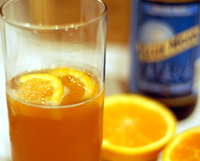
  • Blue Moon: (Full disclosure: if someone else is paying, I’ll order a Blue Moon. With the orange.) Socially liberal, these people hate moral authority and can be sarcastic when trying to get a point across. Wow, who’d have guessed? Sorry, I was being sarcastic. They are also a whopping 105 percent more likely to drive a hybrid car, 77 percent more likely to own a Mac laptop, and 65 percent more likely to buy five or more pairs of running shoes annually.
  • Craft Beers: People who go out of their way to order the most obscure beer on tap are open-minded, intellectually curious, and seek out interesting experiences. They are happy-go-lucky as they buy their organic products (which they are 153 percent more likely to do), and watch The Office, which they 52 percent more likely to do. They are also 36 percent more likely to be the one who gets to choose which movie we’re going to see.
  • No Beer: Remember all those people who wanted to have a beer with Pres. Bush, who himself doesn’t drink? Well, they probably didn’t vote for him but the abstainers did. People who don’t drink beer were found to be social conservatives who don’t like loosening up and see most issues in black and white. They honor authority and are 50 percent more likely to register Republican.
Xtreme Branding: Kellogg’s Plan is Flaky
Patricia | Oct. 15, 2009

corn-flakesThe prize for a news story you’d swear was fake is a report that cereal maker Kellogg’s is testing a system to apply its logo to individual corn flakes in the United Kingdom. In announcing the program on its UK Twitter stream, the company said, “Now you’ll always be able to tell your Corn Flakes from corn fakes.”

Really?

Kellogg’s was evidently so concerned about store-brand cereal sales that it began developing laser technology to brand the flakes without altering the taste, and somehow, not break them into bits. It will then insert some percentage of branded flakes in with the plain ones so the British cereal eater will always know they are getting that special Kellogg’s goodness.

‘In recent years, there has been an increase in the number of own brands trying to capitalise on the popularity of Kellogg’s corn flakes,’ said Helen Lyons, lead food technologist at the company.

‘We want shoppers to be under absolutely no illusion that Kellogg’s does not make cereal for anyone else. We’re constantly looking at new ways to reaffirm this and giving our golden flakes of corn an official stamp of approval could be the answer.’

If it works well, the company plans to brand its other flake cererals, including Frosted Flakes and Special K. No word yet on when Rice Krispies will get the treatment.

Case Study: How Not to Handle Criticism
Patricia | Oct. 9, 2009

lauren-adAds are supposed to provide information to consumers that will sway them to buy products or services. Consider a recent Ralph Lauren ad a big FAIL in that department. The company’s reaction to criticism, however, did reveal something useful: they don’t get it.

It all started, according to a recent ABC story, when PhotoShop Disasters noted the obvious photo retouching that turned a human woman into a Barbie Doll by subtracting ribs and connective tissue via computer. Ralph Lauren threatened to sue, demanding the story and image be taken down, which the site’s ISP did.

By then, however, Boing Boing has already posted on the subject, and went PsD one better by not only criticizing the original ad, but Ralph Lauren’s reaction.

…instead of responding to their legal threat by suppressing our criticism of their marketing images, we’re gonna mock them.

…to Ralph Lauren, GreenbergTraurig, and PRL Holdings, Inc: sue and be damned. Copyright law doesn’t give you the right to threaten your critics for pointing out the problems with your offerings. You should know better. And every time you threaten to sue us over stuff like this, we will:

a) Reproduce the original criticism, making damned sure that all our readers get a good, long look at it, and;

b) Publish your spurious legal threat along with copious mockery, so that it becomes highly ranked in search engines where other people you threaten can find it and take heart; and

c) Offer nourishing soup and sandwiches to your models.

ABC printed Ralph Lauren’s acknowledgment that the ad is, well, terrible.

“For over 42 years we have built a brand based on quality and integrity. After further investigation, we have learned that we are responsible for the poor imaging and retouching that resulted in a very distorted image of a woman’s body. We have addressed the problem and going forward will take every precaution to ensure that the caliber of our artwork represents our brand appropriately.”

But the company has yet to back off its threats to sue critics. This is not, as you might imagine, the way to handle mistakes in the era of Facebook and Twitter and so-called “consumer conversations.” Lawyering up because someone posted your graphic — not to steal it but to critique it — is so last-century. Then again, so is picturing lollypop-headed models, even when you have to make them up.

Maron on Facebook: “Please Validate Me”
Patricia | Sep. 30, 2009

marc-maronI’ve been listening to the free Marc Maron podcast since it started a few weeks ago. Maron, a former member of Air America’s “Morning Sedition” show, interviews other comedians and provides general commentary on subjects ranging, so far, from Whole Foods to Facebook. And his comments about Facebook have me thinking.

Even though I’ve been on Facebook for about a year (I think), and Twitter for a little less, I’ve been suspect of the imperatives to heed the supremacy of social networking. Is social networking the means or the goal? Maron, a self-described 12-Step program member, has an answer. (Warning: Maron’s podcast is adult-oriented.)

…now I’m beginning to become concerned with the addictive nature that I have with other things because the amount of time I spend on these things. I’m gonna cop to this. I don’t even know how many times I check to update my status update on Facebook. I don’t even know.

I’m ashamed of it. Because I’ll put something up on my status bar and I will sit there and I’ll wait for people to write in, and I’ll watch what they say. And it’s like a speedball. Like, “Oh that person likes me. Well that was a little negative. Maybe I should respond to that. Oh fuck that guy. I’m definitely gonna respond to THAT.” I mean this goes on all day long. Twitter? The same thing.

These are like – it comes out of this neediness to connect. It comes out of the neediness to avoid myself. It comes out of the neediness to reveal myself, and also just a need to be distracted and to feel the excitement of people responding to me…

Every status update on Facebook should just be, “Hey, would somebody please, uh, validate me please? Let me just update my status. I need validation. Hold on, let me update my status. Hey I’m here. Is anyone else out there? Hold on, I have to update my status. How great am I? Am I pretty good? Hold on, let me update my status. Look, this is something I thought of. Isn’t it wonderful? Hold on, I’m going to update my status. I’m a little sad. Could somebody throw me a line?”

It never ends. It’s a waste of time. But it’s what fuels this entire technological boom. I’m not sure this social networking means anything, other than people need to be validated, even if it’s ever so briefly.

With most Facebook updates alternating between a recitation of people’s to-do lists, reactions to celebrity deaths, inane quiz results, and advice about business (”Gain the market edge through social networking!”), I think Maron is right. As we pursue quantity, not quality, in our “friends” and “followers,” we either keep our updates to the mundane and meaningless, or make our not-really friends cringe at too much information. In the end, all anyone wants is to be told they’re doing O.K., they’re keeping up, they’re on the path to…whatever. And that’s all people wanted long before social networking came along.

Fall Fashions Make Me Consider Jumping from the Plane
Patricia | Sep. 11, 2009

100085530_316When I heard fashion and design are revisiting the ’80s this fall, I had mixed feelings. For one thing, who doesn’t look better with shoulder pads? On the other hand, there was some really stupid stuff back then. Surely, for example, we don’t need to revive Members-Only jackets or parachute pants.

And then I opened the new Chico’s catalog and saw these. Does it get any worse? I applaud moving on from the ’70s-era elephant-leg pants and going back to a narrower ankle — but no elastic, please. Also pictured in the catalog: leggings, python prints, and lace-front vests. I’ll try to move on (or back) with the times, but you’d think one season of paratrooper pants in a lifetime was more than enough.

This latest revival makes me worry a bit for creativity in general. Since the ’80s was the last time music did anything truly new until rap came along, I wonder if all we as a species are capable of anymore is derivation. When the most popular video game in 2009 lets you be a member of The Beatles, a band that broke up 40 years earlier, it says a lot about whether we’ve thrown in the towel on surpassing ourselves. I’m not saying that every generation doesn’t revisit prior ones, just that it seems like we’ve been stuck in all things Baby Boomer for longer than we should. As a member of the overlooked and possibly nonexistent “Generation Jones,” I am ready to move on. So what’s new?

Marketing, advertising, politics, dogs
Patricia | Sep. 1, 2009

“Content drives action.”
— David Meerman Scott, author, The New Rules of Marketing & PR (1961 – )

“When you cannot make up your mind which of two evenly balanced courses of action you should take, choose the bolder.”
— Field Marshal William J. Slim, Governor-General of Australia (1891 – 1970)

“Happiness is dog-shaped, I say.”
— Chapman Pincher, writer (1914 – )